
Executive Summary
Project controls is one of the least understood but most consistently in-demand disciplines in Texas construction, energy, and capital projects. It sits underneath job titles like cost engineer, scheduler, planner, and project controls manager — and on large EPC and data center builds, it's often the function standing between a project finishing on budget or blowing past it.
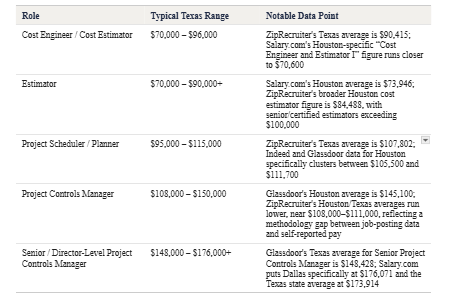
Compensation in this field varies more by seniority and certification than almost any other technical discipline covered in this library. Entry-level cost engineers and estimators in Texas typically start in the $65,000–$85,000 range, while certified project controls managers on large capital programs routinely clear $140,000–$175,000, with senior and director-level professionals pushing past $190,000 on the biggest projects. This guide breaks down what each role pays across Texas, how pay shifts by city and industry, and what certifications actually move the needle.
What Project Controls Means
AACE International — the field's primary professional association — describes project controls as spanning planning, scheduling, cost estimating, forecasting, performance measurement, and risk management: the disciplines that keep a project's budget and timeline honest from kickoff to closeout. In practice, it's less a single job than a family of specialized roles that all feed the same goal — knowing, at any point in a project, exactly where cost and schedule actually stand versus the plan.
The Core Functions
Cost Engineering — estimating, forecasting, and tracking project costs against budget
Planning & Scheduling — building and maintaining the project schedule, tracking float, and flagging delays before they cascade
Estimating — pricing scope before and during execution, from conceptual budgets to detailed bids
Risk Management — quantifying schedule and cost risk and building contingency into the plan
Market Overview
Demand for project controls talent in Texas tracks closely with the state's broader capital-projects boom. Nationally, the Associated Builders and Contractors estimates the construction industry needs roughly 349,000 net new workers in 2026 to keep up with demand, and industry surveys find 92% of construction firms currently struggling to fill open roles. That shortage isn't evenly distributed — skilled trades get most of the headlines, but planning, scheduling, and cost control roles are just as exposed because they can't be filled quickly with entry-level hires.
Data center construction is intensifying that pressure specifically. A 2026 labor market report on data center construction identified a nationwide shortage of roughly 499,000 workers, with project managers named among the hardest roles to fill — a category that overlaps directly with project controls and scheduling talent. The same report found data center construction paying wage premiums of up to 30% to pull skilled workers away from traditional sectors, a dynamic that's pushing project controls compensation upward across Texas as employers compete for the same limited pool.
Salary by Position
Project controls titles aren't standardized across employers, so the same responsibilities can carry different job titles — and different pay — depending on the company. The ranges below reflect the spread across major salary platforms as of mid-2026.
Salary by City
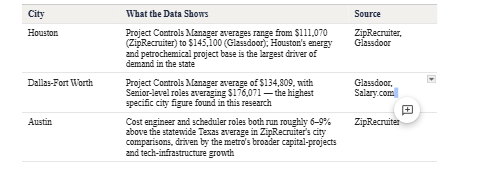
Project controls pay in Texas isn't as evenly distributed across metros as it is for some other technical fields, largely because so much of the demand is concentrated where large energy, petrochemical, and data center capital projects are actually being built.
Salary by Industry
Glassdoor's Houston-specific data on project controls managers shows Energy, Mining & Utilities paying the highest median total pay at $163,775, with Construction, Repair & Maintenance Services close behind at $159,954. That ordering lines up with where the biggest, most complex capital projects in the state are concentrated — megaprojects in energy and petrochemicals have historically driven the most mature (and best-compensated) project controls functions.
Data centers are the fastest-growing source of new demand, even though dedicated salary data for project controls roles specific to data center construction is still thin. The overlap is clear from hiring reports, though: data center construction's well-documented labor shortage explicitly includes project management and controls-adjacent roles among its hardest to fill, and the sector's wage premiums are pulling planning and cost talent away from more traditional energy and infrastructure projects.
Career Progression
Project controls careers tend to follow a fairly linear path, with pay increasing at each rung roughly in line with the ranges above.
Entry-level cost engineer, estimator, or scheduler (0–3 years) — typically $65,000–$85,000, often within a rotational or graduate program at a larger EPC firm
Senior cost engineer / senior scheduler (3–8 years) — typically $85,000–$115,000, often the point where a first AACE or PMI certification becomes realistic
Project controls lead (7–12 years) — typically $110,000–$140,000, managing controls for a single project or major work package
Project controls manager (10+ years) — typically $130,000–$150,000+, owning controls across a full project or portfolio
Senior / director-level project controls manager (15+ years) — typically $148,000–$176,000+, often overseeing controls across multiple concurrent megaprojects
Certifications
AACE International is the primary certifying body for project controls specifically, and it offers a family of credentials rather than one single certification.
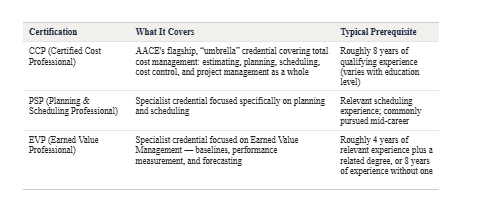
AACE credentials require renewal every 3 years, typically through 12 continuing education units or by re-sitting the exam. AACE's certifications sit alongside PMI's project-management-focused credentials — including thePMP covered in this library's certification comparison — and it's increasingly common for senior project controls professionals to hold both an AACE credential and a PMP, since the two validate different but complementary skill sets.
Skills
Scheduling software proficiency — Primavera P6 remains the industry standard on large capital projects (see this library's Primavera P6 hiring guide)
Cost forecasting and earned value analysis — the technical core of the discipline, increasingly expected even at mid-level roles
Data and reporting tools — job postings reviewed for this guide commonly list Power BI, Cognos, and Maximo alongside traditional project controls software
Contract and commercial fluency — senior roles increasingly expect an understanding of contracting strategy, not just internal cost tracking
Regulatory familiarity — roles tied to utilities and energy infrastructure often expect working knowledge of the relevant regulatory bodies overseeing the project
Hiring Outlook
The same forces shaping Texas's broader engineering and construction hiring market apply directly to project controls. Addison Group's 2026 workforce research describes roughly three open engineering-adjacent roles for every qualified candidate nationally, with project roles specifically named as being in high demand in growth markets like Texas. Burnett Specialists' 2026 Texas research points to the same shortage extending across manufacturing, energy, construction, and infrastructure, driven by accelerating demand, retirements among experienced staff, and increasingly specialized skill requirements.
Layered on top of that general shortage is data center construction's own labor crunch, which is pulling planning, scheduling, and cost talent toward projects offering premium pay. For employers, that means project controls hiring in 2026 increasingly means competing not just with other EPC firms, but with an entirely new category of high-paying mission-critical construction employer.
Frequently Asked Questions
What does a project controls professional do?
They track and manage a project's cost and schedule performance — building estimates, maintaining the schedule, forecasting costs, and flagging risk before it turns into a budget overrun or missed deadline.
What is the average project controls salary in Texas?
It depends heavily on role and seniority. Entry-level cost engineers and schedulers typically start in the $65,000–$85,000 range, while project controls managers average $108,000–$150,000, and senior/director-level professionals can clear $175,000.
Which Texas city pays project controls professionals the most?
Dallas-Fort Worth shows the highest specific figures found in this research, particularly at the senior level, though Houston has the largest overall market given its concentration of energy and petrochemical capital projects.
What certifications boost project controls salary the most?
AACE's CCP is the field's flagship, most broadly recognized credential. PSP and EVP are strong specialist options for scheduling- or earned-value-focused roles. A growing number of senior professionals pair an AACE credential with a PMP.
How do I move from cost engineer to project controls manager?
The typical path runs through senior cost engineer or senior scheduler roles, then a project controls lead role managing controls for a single project or major work package, before stepping into a full project controls manager role overseeing an entire project or portfolio — usually alongside a first AACE certification along the way.