
Executive Summary
In the U.S. construction and real estate market, “cost manager” and “quantity surveyor” cause more confusion than almost any other pair of job titles — and the honest answer is that, in practice, American employers frequently treat them as the same role. Real job postings from major global firms operating in the U.S. — including postings specifically in Houston — list openings as “Senior Cost Manager / Quantity Surveyor” for the exact same position, sometimes on data center projects specifically.
That said, the terms aren't perfectly interchangeable everywhere, and understanding where they overlap and where they diverge matters for both employers writing job descriptions and candidates evaluating offers. This guide breaks down what each role actually does, how pay compares, what certifications matter, and which title to use when you're hiring for one.
What a Cost Manager Does
A cost manager is the U.S.-native term for the professional who manages a construction project's budget from planning through closeout — developing cost estimates, tracking spend against budget, managing change orders, and reporting cost status to ownership. It's the term most commonly used inside American commercial real estate and construction firms.
What a Quantity Surveyor Does
Quantity surveyor (often shortened to “QS”) is the term used across the UK, much of the Commonwealth, and by international firms operating in the U.S. It covers essentially the same functions — cost planning, estimating, procurement support, and cost control through the life of a project — but the title carries a more formal, credentialed tradition behind it, rooted in RICS (Royal Institution of Chartered Surveyors) professional standards.
Pre-Contract vs. Post-Contract Duties
Both roles typically split their work into two phases, regardless of which title is used:
Pre-contract — feasibility cost studies, conceptual and detailed cost estimating, cost planning against design development, procurement strategy support, and bid/tender evaluation
Post-contract — change order management, progress valuations and payment certification, cost reporting against budget, final account settlement, and dispute support when needed
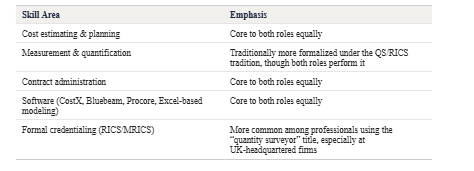
Where firms draw a distinction, it's usually that “quantity surveyor” implies a somewhat more rigorous, formally trained approach to measurement and valuation — a legacy of the RICS tradition — while “cost manager” is used more loosely in the U.S. to describe anyone doing the same job, credentialed or not.
Skills Comparison
Salary Comparison
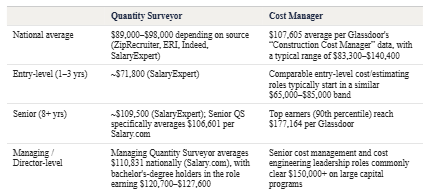
Salary data for both titles overlaps heavily in the U.S., which reinforces how interchangeably employers actually use them.
The overlap isn't a coincidence. Job postings from Turner & Townsend — one of the largest cost consultancies operating in the U.S. — list identical openings under both titles across multiple American markets, including “Senior Cost Manager / Quantity Surveyor – Data Center Construction” in Houston specifically, alongside similar dual-titled postings in New York, San Jose, Boise, and Charlotte.
RICS / MRICS
RICS is the professional body most closely associated with the quantity surveying tradition, and achieving chartered status (MRICS) requires completing the Assessment of Professional Competence (APC) — typically 24 months of structured training plus a minimum of 96 hours of continuing professional development for candidates starting from an RICS-accredited degree, with shorter structured-training paths available for candidates who already have 5 or 10 years of relevant experience. Chartered surveyors use the MRICS or FRICS designation and gain access to a globally recognized professional network.
AACE Credentials (CCP, CEP)
On the American “cost manager” side, AACE International's Certified Cost Professional (CCP) is the closest equivalent flagship credential — covered in more depth in this library's Texas Project Controls Salary Guide — and AACE's Certified Estimating Professional (CEP) is a useful complementary credential for cost managers whose work leans heavily toward estimating.
In practice, candidates working in the U.S. under either title increasingly hold a mix of both traditions: an AACE credential for domestic credibility and an RICS/MRICS designation for firms with international ownership or global cost-consultancy clients.
Career Path
Graduate / Assistant Cost Manager or QS — entry point, typically averaging in the mid-$70,000s per Salary.com's graduate QS data
Cost Manager / Quantity Surveyor — core working-level title, averaging roughly $90,000–$110,000 depending on source
Senior Cost Manager / Senior Quantity Surveyor — typically $106,000–$140,000, often the point where RICS or AACE certification becomes a real differentiator
Managing / Director of Cost Management — $110,000–$150,000+, overseeing cost management across a full project or portfolio
Industries
“Quantity surveyor” appears most often at firms with UK or Commonwealth roots operating in the U.S. — global cost consultancies like Turner & Townsend and certain divisions of CBRE are the clearest examples — and in industries with heavy international investment, like large-scale commercial real estate and data centers. “Cost manager” is the more common default at U.S.-headquartered general contractors, developers, and owner's-rep firms. In fast-growing sectors like data center construction, job postings reviewed for this guide show both titles used side by side for what is functionally the identical role, including in Houston specifically.
Which Role Should You Hire?
If you're a U.S.-based general contractor or developer without international ties — “cost manager” is the more familiar title for domestic candidates and will likely draw a larger applicant pool
If you're working with an international cost consultancy, or the project has UK/Commonwealth-based ownership or partners — “quantity surveyor” may be the expected title, and RICS credentialing may carry more weight with those stakeholders
If the role is on a data center or large capital project — don't assume either title excludes qualified candidates; post under both, the way major cost consultancies already do, to maximize your applicant pool
What actually matters more than the title — confirm whether the role is pre-contract (estimating/cost planning) or post-contract (cost control/change management) focused, since candidates often specialize in one side more than the other regardless of title
Hiring Advice
Employers unfamiliar with the quantity surveyor title sometimes worry they're searching for a different skill set than what they actually need, or that QS candidates are trained on UK cost standards that won't translate to U.S. practice. In most cases, that concern is overstated — the underlying cost management skill set is highly transferable, and RICS-trained candidates are generally quick to adapt to U.S. contract and estimating conventions, particularly on international-facing capital projects like data centers where U.S. and global practices already blend.
Frequently Asked Questions
Is a cost manager the same as a quantity surveyor?
In practice, often yes. Major cost consultancies operating in the U.S. — including on Houston data center projects — list identical job openings under both titles. The core responsibilities (cost planning, estimating, and cost control) overlap heavily.
Which role pays more — cost manager or quantity surveyor?
Salary ranges overlap substantially and depend more on seniority, employer, and project type than on which title is used. Cost manager data (particularly Glassdoor's Construction Cost Manager figures) runs slightly higher on average, but quantity surveyor postings at senior levels are competitive with or ahead of that.
Do U.S. construction firms use quantity surveyors?
Yes, particularly at global cost consultancies and on projects with international ownership or investment — data center construction is a common example given how much international capital flows into that sector.
What certifications matter most for each role?
RICS/MRICS is the traditional credential most associated with the quantity surveyor title. AACE's CCP and CEP are the closest American equivalents, more commonly held by professionals using the cost manager title. Increasingly, candidates in either role hold a mix of both.
Which role should I hire for a data center or EPC project?
Don't over-index on the title. Post under both “cost manager” and “quantity surveyor” to maximize your applicant pool, and evaluate candidates on whether their experience is pre-contract (estimating) or post-contract (cost control) focused, since that distinction matters more than which job title they've historically held.