
Executive Summary
Data center construction is one of the fastest-growing, best-paying segments in U.S. construction and engineering right now, and the gap between it and standard commercial work keeps widening. Entry-level data center technicians start in the high $50,000s to low $60,000s, while experienced commissioning engineers and project managers on hyperscale builds are clearing $250,000–$340,000 in total compensation. In between sits a wide band of MEP engineers, estimators, superintendents, and controls specialists, nearly all of whom are being pulled toward data center work by pay that consistently outruns the rest of the construction industry.
The driver behind all of it is straightforward: AI and cloud infrastructure spending is growing faster than the skilled workforce that builds it. This guide breaks down why the sector is growing, what each role actually pays, where the hiring hotspots are — including Texas — and what employers need to know to compete for a shrinking pool of qualified talent.
Why Data Centers Are Growing
The scale of the buildout is difficult to overstate. Industry labor research puts global data center spending at roughly $3 trillion over the next five years, and U.S. data center construction spending specifically is projected to grow 17–20% in 2026 alone, driven by AI, cloud computing, and hyperscale demand. The International Energy Agency projects global data center electricity demand will more than double by 2030, from about 415 terawatt-hours in 2024 to roughly 945 terawatt-hours — a scale of growth that requires a corresponding scale of physical construction.
Project size is growing just as fast as spending. DataBank's own 2026 construction outlook describes campuses that once required around 750 workers now needing 4,000–5,000 — essentially the workforce of a small city on a single project site, built and staffed on a compressed timeline.
Data Center Construction Market
Texas & the Gulf Coast Growth Corridor
Northern Virginia remains the country's largest and most mature data center market, but Texas — and Dallas specifically — has emerged as one of the fastest-growing corridors in the country. Industry hiring coverage describes workers actively relocating from Arizona, where power constraints have slowed construction, toward Dallas's booming project pipeline. Other high-growth markets include New Albany, Ohio; Reno-Sparks, Nevada; Phoenix, Arizona; and the San Francisco Bay Area, which one 2026 industry report identifies as the leading market specifically for data center project manager compensation.
Top Hiring Roles
Project Managers — oversee planning, budget, schedule, and multi-discipline coordination across electrical, mechanical, controls, and architectural scopes
MEP Engineers — mechanical, electrical, and plumbing design and delivery, the technical backbone of every data center build
Commissioning Agents / Engineers — test, verify, and document that electrical, mechanical, and controls systems perform as designed before turnover
Construction Superintendents — run day-to-day field operations and crew coordination on-site
MEP-Experienced Estimators — price the mechanical and electrical-heavy scope that makes up the bulk of a hyperscale build's cost
Recruiting firm Amundson Group's 2026 data center hiring research singles out two roles as the hardest to fill in the current market: MEP-experienced estimators and commissioning engineers — both are described as roles general contractors have never needed to staff at this volume before, drawing from a genuinely small candidate pool.
Salary Benchmarks
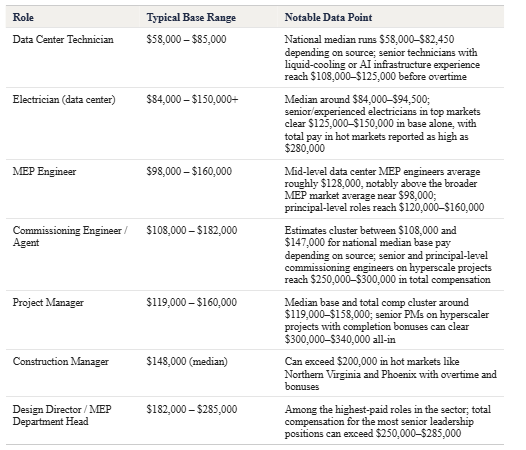
Data center salary data varies more by source than almost any other role covered in this library, partly because “data center” job titles aren't standardized and partly because total compensation — bonuses, per diem, overtime, RSUs at hyperscalers — can add tens of thousands of dollars on top of base pay. The ranges below reflect the spread across the sources reviewed for this guide.
Hiring Demand
Demand is concentrated in a handful of metros absorbing the bulk of new hyperscaler investment. Northern Virginia remains the largest and deepest market, with the most mature local labor pool and correspondingly high pay floors. Texas — particularly Dallas — is one of the fastest-growing corridors nationally, pulling talent from slower markets. Ohio, Nevada, and Arizona are each absorbing multi-billion-dollar hyperscaler announcements that require importing labor faster than local markets can supply it, driving some of the most aggressive relocation and per diem packages recruiters report seeing.
Most In-Demand Skills
Deep MEP-side technical knowledge — the ability to work across mechanical, electrical, and controls scope simultaneously, which is what makes MEP estimators and commissioning engineers so hard to source
Liquid cooling and high-density AI rack deployment experience — an increasingly specialized skill set as AI infrastructure drives cooling requirements far beyond traditional data hall design
BIM and project management software fluency — Procore, MS Project, and Bluebeam are consistently listed in data center construction job postings
Code and regulatory fluency — NFPA, NEC, IBC, and general life-safety/egress requirements come up repeatedly in data center construction and commissioning job postings
Controls and building automation systems (BAS) expertise — critical for commissioning and ongoing operations alike
Candidate Availability
The talent pool for the hardest-to-fill roles is genuinely small, not just tight. Recruiting firm Amundson Group describes every experienced data center project manager, superintendent, MEP-savvy estimator, and commissioning engineer as being called weekly by three or four general contractors simultaneously — and describes retention as harder than it's been in a decade. Industry salary research on commissioning specifically calls the talent pool “small,” noting that operators pay large premiums simply to secure senior experts capable of stabilizing delivery on multi-hundred-megawatt builds.
Hiring Challenges
Talent scarcity against extreme demand — a 2026 labor market report projects the industry will need up to 499,000 workers, with roughly 41% of the existing skilled trades workforce projected to retire by 2031
Speed-to-hire pressure — data centers generate revenue the moment they go live, and one industry estimate puts the cost of delaying a 60-megawatt facility at roughly $14.2 million per month in lost revenue, which pushes employers toward paying whatever it takes to stay on schedule
Direct competition with traditional construction — electrical work alone makes up roughly half of all labor on a typical data center project, pulling electricians specifically out of every other construction segment at once
Roles that didn't exist at this scale before — general contractors have never had to staff MEP estimators and commissioning engineers in the volumes today's hyperscale projects require, and the experienced candidate pool hasn't caught up
Future Hiring Forecast
Nothing in current data points toward this easing soon. Data center construction spending is projected to grow 17–20% in 2026 alone, and data center salaries broadly have climbed roughly 18% over the past three years according to one industry salary guide — a pace unlikely to slow while AI infrastructure investment continues at its current trajectory. One notable wrinkle: a retention-bonus cliff tied to bonuses issued in 2023–2024 is expected to release some senior talent back into the market in late 2026 through mid-2027, but industry recruiters expect that supply to be more than absorbed by the next wave of hyperscaler capital spending.
Employer Recommendations
Budget for data center-specific pay from the start, not as a change order — benchmarking against general commercial construction or engineering salary data will consistently underprice the roles that matter most
Move on staffing before the project breaks ground — experienced, mission-critical talent doesn't stay available long once a serious project is announced
Don't rely on job boards alone for the scarcest roles — MEP estimators and commissioning engineers in particular are more often reached through direct outreach and specialized recruiting than open postings
Treat certifications as a hiring lever, not just a resume line — CDCP, CxA, and PMP all show measurable pay and hiring-preference impact, and employers who reimburse certification costs have an edge in retention
Plan for both a technical and a management career track — the data shows meaningfully different pay ceilings for each, and offering a clear path in both directions helps retain senior technical talent who don't want to move into pure management
Frequently Asked Questions
What roles are in highest demand for data center construction?
MEP-experienced estimators and commissioning engineers are consistently named as the hardest to fill, alongside project managers, MEP engineers, and experienced electricians.
How much do data center project managers earn?
Typically $119,000–$160,000 in base/median total compensation, with senior project managers on hyperscaler projects clearing $300,000–$340,000 all-in once bonuses are included.
Why is data center hiring accelerating in 2026?
AI and cloud infrastructure investment is driving data center construction spending up 17–20% in 2026 alone, and individual project sites now require thousands of workers where hundreds sufficed a few years ago — demand the existing skilled workforce hasn't caught up to.
What certifications help candidates get hired faster?
CDCP is frequently listed as preferred for project management and engineering roles. PMP adds measurable value for engineers moving into management. CxA certification (via BCxA or ASHRAE) is the clearest lever for commissioning-specific roles.
Which regions have the strongest data center hiring demand?
Northern Virginia remains the largest, most established market. Texas — especially Dallas — is one of the fastest-growing corridors nationally. Ohio, Nevada, and Arizona are also absorbing major hyperscaler investment and importing talent to keep up.