
Executive Summary
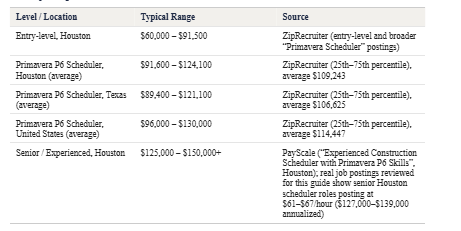
A Primavera P6 scheduler is one of the easiest roles to under-hire for — the software is complex enough that a resume listing “P6 experience” can mean anything from basic activity updates to building and defending a fully resource-loaded, multi-thousand-activity master schedule. In Texas, Primavera P6 schedulers currently average $107,000–$115,000 depending on the data source, with senior and experienced schedulers in Houston specifically clearing $125,000–$150,000 in total pay.
This guide is built for employers, not candidates: what the software actually does, what a good scheduler's day-to-day responsibilities look like, which skills and certifications separate a real scheduler from someone who's opened the software a few times, what to ask in an interview, and how long a realistic hiring process should take.
What Primavera P6 Is
Primavera P6 (formally Oracle Primavera P6 Enterprise Project Portfolio Management) is the scheduling software standard on large capital projects across energy, oil & gas, EPC, infrastructure, and increasingly data center construction. It's built to handle schedules with thousands of interdependent activities, multiple resource pools, and complex logic — well beyond what general-purpose tools like Microsoft Project are designed for. On the kind of megaprojects Houston's energy and EPC employers run, P6 isn't optional software; it's effectively the industry standard.
Why Scheduling Matters
Impact on Project Cost & Timeline
A schedule isn't a status report — it's the tool that predicts where a project is headed before it gets there. A scheduler who can accurately model critical path, flag float erosion early, and forecast the downstream impact of a delay gives a project team the lead time to fix a problem before it becomes a claim, a change order, or a missed milestone. A scheduler who can't do that reliably turns the schedule into a document nobody trusts — which is arguably worse than having no schedule at all, since it creates false confidence.
Responsibilities
Building and maintaining the master project schedule, including activity sequencing, logic ties, and resource loading
Tracking progress updates and reconciling them against the baseline schedule
Running critical path method (CPM) analysis to identify what's actually driving the project's end date
Flagging schedule risk and float erosion before it becomes a missed milestone
Producing schedule reports and narratives for project leadership, ownership, and sometimes clients directly
Supporting change management and, when needed, forensic schedule analysis for claims or disputes
Required Skills
Technical Skills
Deep, hands-on Primavera P6 proficiency — not just familiarity; the ability to build a schedule from scratch, not just update one someone else built
Critical path method (CPM) analysis
Resource and cost loading within the schedule
Working knowledge of MS Excel for reporting and data manipulation alongside P6
Familiarity with industry scheduling standards and, on larger programs, earned value concepts
Soft Skills
Communication — the ability to explain schedule risk to non-schedulers, including project leadership and clients
Organization and attention to detail, given the volume of activities and dependencies in a typical capital project schedule
Diplomatic persistence — good schedulers have to push back on optimistic progress reporting from field teams without becoming an adversary
Experience Levels
Junior / Entry-level scheduler — typically holds a relevant bachelor's degree (engineering, construction management, or similar), basic P6 proficiency, and sometimes an introductory certification like CAPM; usually works under a senior scheduler updating and maintaining an existing schedule rather than building one independently
Senior scheduler — builds and owns the master schedule independently, runs CPM analysis, and is trusted to report schedule status directly to project leadership
Scheduling manager — oversees scheduling across multiple projects or a full program, sets scheduling standards and templates, and mentors junior schedulers
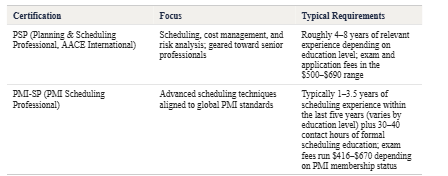
Both credentials require renewal roughly every three years through continuing education or professional development units. Industry research on construction scheduling certifications reports that certified schedulers earn at least 10% more than uncertified peers, which lines up with what job postings reviewed for this guide show directly — PMI-SP or AACE certification is commonly listed as “preferred” even when it isn't formally required.
Interview Questions
Technical Screening Questions
Walk me through how you'd build a schedule baseline from scratch for a project of [relevant size/type].
How do you identify and validate the critical path once a schedule is built?
What's your process when a progress update shows the project is losing float faster than expected?
How do you handle resource-loading conflicts across multiple concurrent activities?
Describe a time you had to reconcile a schedule with a field team's optimistic progress reporting.
Behavioral Questions
Tell me about a time your schedule forecast conflicted with what project leadership wanted to hear. How did you handle it?
Describe the most complex schedule you've owned — how many activities, and what made it complex?
How do you communicate schedule risk to stakeholders who aren't scheduling experts?
A practical screening tip: ask candidates to walk through an actual schedule they've built, live, rather than relying on resume claims alone — the gap between “has used P6” and “can build and defend a schedule in P6” only shows up when you watch someone actually work in the software.
Salary Expectations
Hiring Mistakes
Treating “familiar with P6” and “can build a schedule in P6” as the same thing — they aren't, and only a live working session or a detailed technical interview reliably tells them apart
Writing a job description around software knowledge alone and skipping the communication and stakeholder-management skills that separate a good scheduler from a data-entry scheduler
Benchmarking pay against general “project scheduler” data instead of Primavera P6-specific figures, which tend to run higher given the software's specialization
Moving too slowly on a strong candidate — experienced schedulers with genuine P6 depth are a narrow talent pool, and a drawn-out process risks losing them to a faster-moving competitor
Not clarifying up front whether the role is pure schedule-building or also includes cost/resource loading and reporting responsibilities, which affects both the candidate pool and the appropriate salary band
Hiring Timeline
Scheduling roles fall into the same broader hiring-cycle pressure affecting engineering and project controls talent generally. Industry workforce research on the 2026 market found employers increasingly taking a “wait for the right fit” approach rather than compromising on skills, which has stretched mid- and senior-level technical hiring to roughly 40–50 days in many cases. For a specialized, in-demand role like an experienced Primavera P6 scheduler, a realistic timeline runs 4–7 weeks from job posting to offer for most employers — faster with a focused, proactive search; slower if the process relies solely on inbound applications to a generic job posting.
Frequently Asked Questions
What does a Primavera P6 scheduler do?
They build, maintain, and analyze the project schedule using Primavera P6 — sequencing activities, tracking progress against the baseline, running critical path analysis, and flagging risk before it turns into a missed milestone.
How much does it cost to hire a Primavera P6 scheduler?
In Texas, expect to budget roughly $107,000–$115,000 on average for the role, with senior, experienced schedulers in Houston specifically running $125,000–$150,000 or more.
What questions should I ask in a P6 scheduler interview?
Go beyond resume claims — ask candidates to walk through how they'd build a schedule baseline, how they identify the critical path, and how they've handled schedule risk or optimistic field-team reporting in the past. A live working session in the software is the most reliable way to confirm real proficiency.
How long does it typically take to hire a scheduler?
Plan for roughly 4–7 weeks from posting to offer for an experienced, specialized scheduler. Broader 2026 hiring-market data shows mid- and senior-level technical roles generally taking 40–50 days when employers hold out for the right fit rather than compromising.
What certifications should I look for in a scheduler?
AACE's PSP and PMI's PMI-SP are the two most relevant credentials. Neither is always required, but both are commonly listed as preferred in job postings, and certified schedulers report earning at least 10% more than uncertified peers.