
Executive Summary
What Each Credential Actually Is
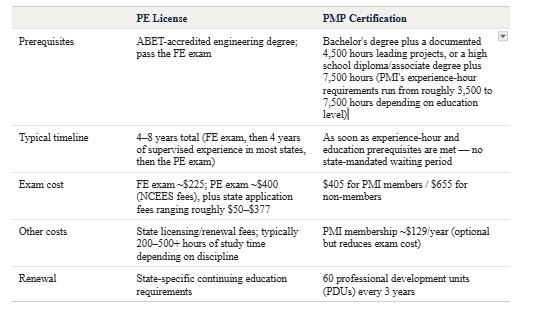
Professional Engineer (PE) LicenseA PE license is a state-issued credential that gives an engineer legal authority to sign and seal engineering documents and take responsible charge of a project. It's discipline-specific (civil, mechanical, electrical, and so on) and administered through NCEES exams plus each state's own licensing board.
Project Management Professional (PMP)PMP is a global, cross-industry certification from the Project Management Institute (PMI) that validates a candidate's ability to lead projects managing scope, schedule, budget, risk, and teams. It isn't engineering-specific and isn't tied to any state; it's earned once and recognized everywhere.
Cost and Time to Earn Each One
The PE Salary Premium
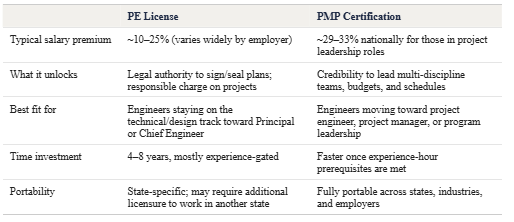
Public salary research on PE licensure is consistent in direction, if not in exact magnitude. Industry salary guide EngineeringRecruiters.com puts the PE premium at roughly 10–15% of base salary. PECivilClick's 2026 analysis of industry surveys puts it closer to 15–25% over non-licensed peers at the same experience level. PEwise's licensing-focused research found premiums ranging from about $5,000 to over $42,000 annually for civil engineers specifically, with most engineers seeing an immediate $5,000–$15,000 bump.
Real-world raises vary more than the averages suggest. In an informal Glassdoor community discussion, engineers who'd just earned their PE reported outcomes ranging from a fixed $10,000 raise written into their employment contract, to a 5–15% bump layered on top of a normal annual increase, to no raise at all in a couple of cases — a reminder that the premium is real in aggregate but not guaranteed at any single employer. Recruiting firm CalTek Staffing frames the license's real value differently: it isn't just a pay bump, it's access to higher-scope, higher-billable work — CalTek documented a $12,000 pay gap tied directly to the additional scope a license makes possible, separate from tenure or negotiation.
At the higher end, ASCE's 2024 Salary Report found the median pre-tax income for PE-licensed civil engineers reached $140,000, compared with a $98,540 national median for civil engineers overall (BLS OEWS data) — though that comparison blends licensure with seniority, since PE holders tend to be further into their careers.
The PMP Salary Premium
PMP's salary data is more centralized because PMI runs its own global survey. The 13th edition of PMI's Earning Power survey found U.S. PMP holders reported a median salary of $130,000 versus $90,000 for non-certified project management professionals — and PMI's global data across 21 countries shows certified professionals earning about 33% more on average. A separate, more recent analysis puts the U.S. figure closer to a 29% premium ($120,000 vs. $93,000). PMI also reports that professionals with 5–10 years of PMP tenure see a median salary of $139,000, climbing further after 10+ years.
The catch for engineers: PMP's premium is largest for people who are actually managing projects, not designing them. An engineer who stays in a pure technical/design role won't see the same lift a project engineer or program manager sees from the same credential.
Side-by-Side Comparison
Why the Highest Earners Often Hold Both
PE and PMP aren't really competing for the same job. A PE proves an engineer can be trusted with technical authority; a PMP proves they can be trusted to run the project around that technical work. On large capital projects — the kind Houston's EPC and energy employers run constantly both skill sets show up in the same role more often than not. CalTek Staffing's assessment of stacked credentials is direct: the two compound rather than duplicate value, particularly for engineers whose roles already include non-design work like procurement, stakeholder coordination, and risk management.
This shows up in real hiring language, too. Job postings reviewed for Houston's data center and industrial market commonly pair a PE requirement with years of hands-on design and delivery experience the kind of role where a PMP on top of the license signals someone who can own the full project lifecycle, not just the engineering scope.
Which Should You Get First?
Staying technical, aiming for Principal or Chief Engineer — prioritize the PE. It's the credential that unlocks the work itself, and PMP without it won't open design-authority roles.
Already managing schedules, budgets, or multi-discipline teams — PMP will likely move your pay faster, since the premium is concentrated in project leadership roles.
Targeting a project engineering or program leadership track in EPC, energy, or data centers — plan for both. The PE typically comes first since it's experience-gated over several years; PMP can often be layered on once you're leading larger scopes.
Early career and unsure which direction you'll go — the FE exam (the first step toward a PE) is worth taking near graduation regardless, since some states make it harder to sit for later once you're removed from coursework.
Frequently Asked Questions
Is a PE or a PMP better for engineers?
Neither is universally better — it depends on career direction. PE pays off more for engineers staying on the technical/design track; PMP pays off more for engineers moving into project or program management.
Can an engineer hold both a PE and a PMP?
Yes, and it's increasingly common in project engineering and program leadership roles on large capital projects, where both technical authority and project leadership are part of the job.
Which certification is cheaper and faster to get?
PMP is faster once its experience-hour prerequisites are met, since it has no state-mandated waiting period. PE licensure typically takes 4–8 years because most states require about four years of supervised experience between the FE and PE exams.
Does Houston's energy and EPC market require a PE, a PMP, or both?
It depends on the role. Design-authority and signing/sealing roles typically require a PE. Project engineer, project manager, and program leadership roles increasingly list PMP as preferred or required, and the most senior capital-projects roles often expect both.
Do employers actually pay more once an engineer gets certified?
On average, yes — but not automatically or uniformly. Some employers have a fixed raise written into their compensation policy; others require the engineer to negotiate or wait for their next review cycle. The published averages reflect a real trend, not a guaranteed individual outcome.